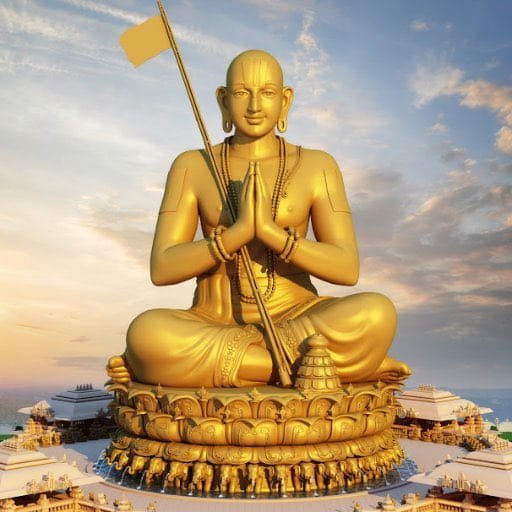
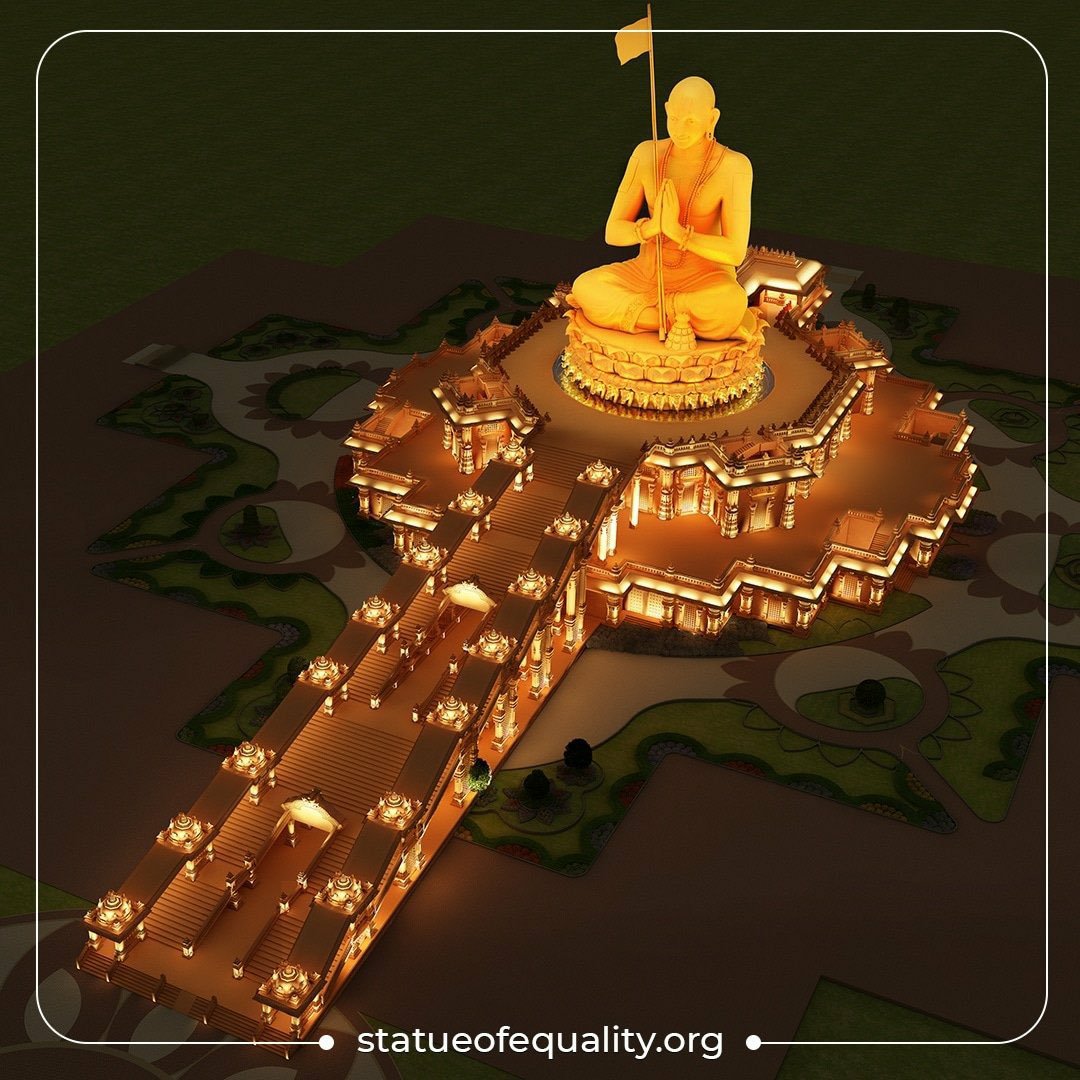
Śrī Ramanuja is considered as one the most important spiritual teachers of Sanathana Dharma, being the leading expounder of Viśiṣṭādvaita – commonly translated as “qualified non-dualism” . He revitalized Indian philosophy with his dynamism so much that nearly every aspect of Hinduism has been influenced by his work.
Ramanuja was born Ilaya Perumal in a Brahmin family in Sriperumbudur, Tamil Nadu, in 1017. From a young age he displayed his intelligence and ability to comprehend highly abstract philosophical points. He had liberal attitudes towards caste and became friendly with a local, saintly Sudra called Kanchipurna, who served in the local Vishnu temple.
Shortly after being married in his teenage years, and after his father’ death, Ramanuja and his family moved to Kanchipuram. There he found his first guru, Yadavaprakasha, a renowned Advaitic scholar. Though his guru was highly impressed with his analytical ability, he was quite concerned on the emphasis Ramanuja placed on bhakti. After frequent disagreements over philosophical interpretations, he left Yadavaprakasa’s tutelage.
Ramanuja then travelled to Srirangam to meet Kanchipurna’s guru Yamunacharya, a philosopher of the Vishishtadvaita school of thought. However, Yamunacharya had died just prior to Ramanuja’s arrival. Followers of Ramanuja relate the legend that three fingers of Yamunacharya’s corpse were curled. Ramanuja saw this and understood that he had been concerned about three tasks. Ramanuja vowed to complete these – write a Visishtadvaita Bhashya for the Brahma Sutras of Vyasa, perpetuate the name of Paraśara, the author of Vishnu Purana, and also ensure that the name of Saint Śaţhakopa would be ever remembered by writing a commentary on the Tiruvoimozhi. Legend has it that on hearing the vow, the three fingers on the corpse straightened.
Ramanuja accepted Yamunacharya as his manasika guru and spent 6 months being introduced to Yamunacharya’s philosophy by his disciple, Mahapurna . Ramanuja realized that his life as a householder was interfering with his philosophical pursuits and so became a sanyasin. Ramanuja started travelling the land, having philosophical debates with the custodians of various Vishnu temples. Many of them, after losing the debates, became his disciples. Ramanuja standardized the rituals and procedures at these temples and increased the standing and the membership of the Srivaishnava school of thought.
When Ramanuja was prevailed upon to assume charge of the seat of Acharya at Srirangam, he wanted to understand the secrets of the three great Mantras and therefore approached Tirukoshtiyur Nambi who gave the upadesa on the condition that he should not give out the secrets to all and sundry and if he did so, he would go to hell.
However, immediately on receiving the upadesa, Ramanuja climbed to the top of the temple gopuram and proclaimed to the large gathering assembled there the way to attain Moksha through the three great Mantras . Nambi was enraged and demanded an explanation. Ramanuja replied that he was ready to go to hell if the people who listened to his proclamation would be saved spiritually.
The Guru was overwhelmed by this reply and embraced Ramanuja and called him ‘Emperumanar and declared that Srivaishnavism would then on be known as Ramanuja Darsanam- the light of Ramanuja.
*Visishtadvaita philosophy*
Ramanuja’s philosophy is referred to as Vishishtadvaita because it combines Advaita (oneness of God) with Vishesha (attributes). Adi Shankara had argued that all qualities or manifestations that can be perceived are unreal and temporary.
According to Vishishtadvaita philosophy, Brahman is eternal, but also includes elements of plurality. The soul, or the Self, and the material world both exist only through Brahman. Vishishtadvaita doesn’t see the world as simply illusion, which would make it separate from Brahman. The material world is a part of Brahman’s nature.. Knowledge (jnana) and devotion (bhakti) are of equal importance.
In Ramanuja’s system, the Lord (Narayana) has two inseparable Prakaras (modes)- the world and the souls. These are related to Him as the body is related to the soul. He is the controlling Reality. Matter and souls are the subordinate elements. They are termed Viseshanas : God is the Viseshya or that which is qualified.
Moksha, or spiritual liberation, is seen as the joy of contemplating Brahman (rather than release from the life-death-rebirth cycle), and that joy is the result of devotion, praise, worship and contemplating the divine perfection.
Ramanuja has written many books of which the most famous work is the Sri Bhashya or Brahma Sutra Bhashya. His Gadhya Thrayam (three prose hymns) – Vaikunta Gadyam, Sriranga Gadyam, and Saranagati Gadyam, are important works in Srivaishnava philosophy.Vedartha Sangraha,Vedanta Saara,Vedanta Deepa Gita Bhashya and Nithya Grantham are his other major contributions to Hinduism.
Ramanuja’s thiruvarasu (sacred burial shrine) is the Ramanuja sannidhi located inside the Sri Ranganathaswamy temple at Srirangam,where he attained his Acharyan Thiruvadi in1137.
 Divinity by Parvathy
Leave a comment